Introduction
Commercial kitchens face evolving food safety expectations. Beyond durable equipment, restaurants, hospitals, school cafeterias, hotels, and catering operations seek materials that reduce contamination risk and meet updated health and environmental requirements. Purchasing decisions have shifted toward stainless steel workstations because they offer reliability, cleanability, and long-term safety, aligning with growing awareness of PFAS-free certifications and antimicrobial hygiene practices.
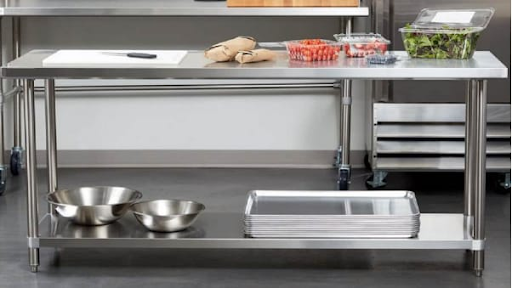
When evaluating commercial kitchen equipment, buyers consider more than counter strength or pan capacity. Chemical migration, corrosion resistance, bacterial growth, and workspace organization carry equal weight in the decision process. A heavy-duty stainless steel work table with integrated drawers supports hygienic food preparation while improving workplace efficiency.
Growing Importance of PFAS-free Food Equipment
PFAS, commonly known as “forever chemicals,” have been the focus of a great deal of attention recently because of their persistence in the environment and possible health impacts. Some industries have started to eliminate or decrease PFAS usage in products that come into contact with food.
There is more demand for equipment that reduces the need for excess chemical exposure in commercial kitchens, especially in institutional kitchens like schools, healthcare centers, and government food services. PFAS-free certification programs promote products containing food-contact surfaces that are free of coatings or treatments that contain PFAS.
Why 304 is a Top Material Choice
The benefit of quality commercial work tables is that they are constructed using 304 stainless steel. This material is rich in chromium and nickel, which form a protective passive film and prevent corrosion, and still provides sanitisation.
In a food safety context, 304 stainless steel has several key benefits:
- High moisture resistance and food acids.
- Smooth surfaces that do not have any holes and do not hold bacteria.
- Easy to be compatible with standard commercial sanitization procedures.
- High life span without surface coatings that can deteriorate.
- Excellent stability with high daily use.
Such properties make 304 stainless steel even more useful when food safety regulations increasingly and persistently demand the use of cleaners and chemically inert food contact surfaces.
Potential Dangers of Pitting Corrosion
Pitting corrosion is one of the underrecognized risks in commercial kitchens. Whereas rusting is easy to spot, pitting is irregular and usually forms minute holes or cavities in the metal surface that slowly continue to penetrate it.
Poor-quality work tables may be produced from lower-quality stainless alloys or lower thickness to lower the production cost. Once the surface is damaged, pitting can start from exposure to chloride from cleaning solutions or salted food.
This is why heavy-duty custom work tables that can help to improve hygiene right away are a great option. Advances in materials and manufacturing quality have helped to maintain clean surfaces that can be more easily disinfected and reduce the number of manufacturing defects that can become contaminated.
Cheap Workbenches vs. Heavy-Duty Custom Workbenches
Although the workbenches may look much the same up front, they will show differences over time in their performance levels.
The low-quality workbenches are frequently constructed using less costly materials, thinner steel, and simpler construction methods. They can bend over time, be prone to scratching, and be vulnerable to moisture and load damage, which may have a negative impact on sanitation.
Heavy-duty custom work benches, on the other hand, are created for challenging business environments. Reinforced structures are more stable when preparing food, and premium stainless steel retains its protective properties even in intensive daily use.
This not only makes the product more durable but also makes it easier to clean, with smooth surfaces that do not accumulate bacteria, and a safer environment for preparing food.
Integrated Drawer Design
Food safety doesn’t just apply to countertop materials; it also applies to the organization of tools and utensils.
One of the biggest operational hazards in commercial food preparation areas is cross-contamination of raw and cooked food. Knives, cutting boards, thermometers, gloves, and preparation tools can be a source for the spread of bacteria from one process to another if they are not stored properly.
The integrated drawer system is a good solution, providing operators with a dedicated storage area under the work surface.
For example:
- Raw meat preparation utensils may be placed in one drawer.
- Cooked food utensils are stored in another drawer.
- Packaging materials can be grouped in separate compartments.
- Common temperature and hygiene materials are readily available.
- Cutting accessories can be color-coded to be stored separately by each food category.
In its standard configuration, the Xinhe WT02-BD features two enclosed drawers paired with an undershelf, offering a practical balance between protected storage and open shelving. The drawers accommodate frequently accessed tools such as thermometers, gloves, and small utensils, keeping them shielded from airborne contaminants and accidental spills. The undershelf below provides additional space for larger items or backup supplies, allowing kitchen staff to maintain an organized workflow without overcrowding the primary work surface. This combination of enclosed drawers and open shelving adapts to varied operational needs while keeping the preparation area uncluttered.
For operations that require more granular separation of tools and ingredients, the drawer count can be customized beyond the standard two-drawer layout, enabling dedicated compartments for each food category or preparation stage.
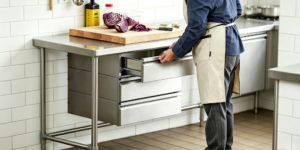
(Image 2Alt:Chef using a heavy duty stainless steel work table with drawers for organized food prep in a commercial kitchen)
Efficiency in the Kitchen: Maintaining a Hygienic Environment
The WT02-BD has a large preparation surface and integrated drawer storage so that the workers can store the required and often-used items at their fingertips and can have a cleaner working area. Enclosed drawers will minimize visual clutter and offer a greater level of protection for smaller tools from airborne contaminants and/or accidental spills than open undershelves provide.
Customization options also optimize business workflow – businesses can order a specific number of drawers, their size, the thickness of the tabletop, reinforcement of the structures, adjustable foot or caster configuration, depending on their needs.
Custom Made Supports Modern Food Safety Practices
Each commercial kitchen is different and will have different needs. Different preparation methods and priorities for storage are used at various restaurants, bakeries, hotels, institutional cafeterias, and catering operations.
Unlike standard work tables, custom stainless steel work tables offer flexibility that can’t be matched. Drawer layouts may be set up to align with a specific production sequence that will ensure separation of ingredients, utensils, and cleaning materials.
Additionally, OEM and ODM capabilities enable distributors and project contractors to create solutions that fit the needs of restaurant chains or hospitality projects requiring standardized hygiene conditions across multiple locations. This standardization simplifies staff training, cleaning procedures, and audit compliance because every location uses equipment configured to the same specifications.
A stainless steel work table configured for current requirements can also accommodate future regulatory changes through modular accessories or reconfigurable storage components.
Conclusion
Food preparation will be safer and more efficient due to higher-quality materials, corrosion resistance, hygienic design, and organized storage. XinHe’s custom stainless steel work table with drawers exemplifies how design can tackle these priorities all in one. Featuring 304 stainless steel construction, its easy-to-clean surface meets current food safety standards, and built-in drawer storage allows for scientific organization and separation of tools for raw foods from cooked foods. When paired with the wide array of customization possibilities, the workstation represents a smart investment for companies.