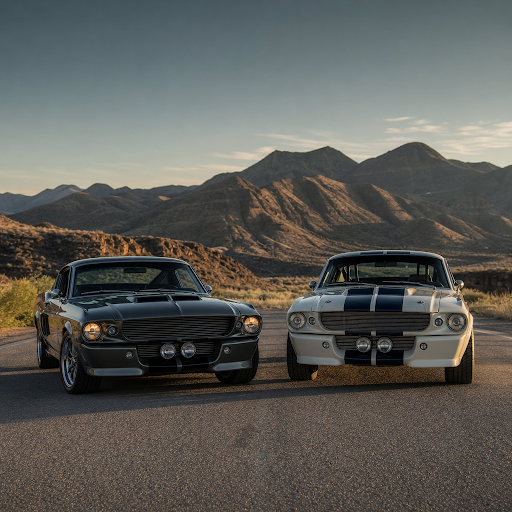
Few debates in the American muscle car world ignite as much passion as the one between the Mustang GT and the Shelby GT. These two icons share a bloodline, a badge, and a legacy — yet they represent fundamentally different philosophies of performance, refinement, and purpose. Whether you are a seasoned collector, a weekend driver, or someone considering a restored classic, understanding the distinctions between these two machines is essential before making any decision. This article breaks down the engineering, heritage, and real-world character of both models to help you navigate one of the most compelling rivalries in automotive history.
A Shared Heritage, A Different Destiny
The Ford Mustang GT and the Shelby GT both trace their roots to the original pony car revolution of the 1960s. Ford introduced the Mustang in 1964, and within two years, Carroll Shelby had transformed it into something far more aggressive — a track-capable machine that would go on to win races and capture imaginations worldwide. The Shelby GT350 and GT500 were not simply upgraded Mustangs; they were purpose-built performance vehicles that redefined what an American sports car could be. The standard Mustang GT, meanwhile, evolved into a more accessible, daily-drivable performance car — powerful, stylish, and broadly appealing without the raw edge of a Shelby.
Carroll Shelby’s Influence on Performance Engineering
Carroll Shelby’s contribution to the Mustang lineage cannot be overstated. His modifications went far beyond cosmetic upgrades. He reworked suspension geometry, installed high-performance engines, and stripped unnecessary weight to create a car that could genuinely compete on road courses. The Shelby GT variants benefited from wider tracks, stiffer springs, and in many cases, supercharged powerplants that pushed output well beyond what the standard GT offered. This engineering philosophy — prioritizing performance above comfort — remains the defining characteristic that separates a Shelby from a standard GT to this day.
Power, Performance, and the Numbers That Matter
When comparing raw specifications, the gap between the Mustang GT and the Shelby GT becomes immediately apparent. The modern Mustang GT is powered by a 5.0-liter Coyote V8 producing around 480 horsepower — a genuinely impressive figure that delivers exhilarating acceleration and a soundtrack that few cars at its price point can match. The Shelby GT500, however, raises the stakes dramatically with its supercharged 5.2-liter Predator V8, generating 760 horsepower. That is not a modest upgrade; it is a transformation. For context, automotive journalists at Jalopnik have noted that the Ford Mustang Dark Horse produces the same horsepower as a Sherman tank, illustrating just how far the Mustang performance family has pushed the boundaries of what a production car can deliver.
Handling and Chassis Dynamics
Horsepower figures alone do not tell the full story. The Shelby GT variants are engineered with a holistic approach to performance — meaning the chassis, brakes, and suspension are all upgraded to handle the additional power responsibly. Brembo brakes, Michelin Pilot Sport tires, and MagneRide damping systems are standard on the GT500, ensuring that the car can stop and corner as impressively as it accelerates. The standard Mustang GT, while capable and fun, is tuned for a broader audience. Its suspension is more compliant, its steering less aggressive, and its overall character more forgiving — qualities that make it an excellent everyday performance car but a step behind the Shelby in pure driving intensity.
The Classic Car Perspective: Restored Mustangs and Collector Value
For collectors and enthusiasts focused on classic and restored models, the GT comparison takes on an entirely different dimension. Vintage Shelby GTs — particularly the 1965–1970 GT350 and GT500 models — command extraordinary prices at auction and are considered among the most desirable American collectibles ever produced. Original, numbers-matching examples can fetch hundreds of thousands of dollars, and even well-executed restorations carry significant premiums. Classic Mustang GTs, while also collectible, are generally more accessible in terms of price and availability. This makes them an attractive entry point for enthusiasts who want the Mustang experience without the financial commitment of a true Shelby.
Authenticity and the Restoration Market
The restoration market for both models is robust and well-supported by a vast network of parts suppliers, specialists, and marque experts. However, the standards for authenticity differ considerably. Shelby restorations are scrutinized intensely by registries and authentication bodies, and deviations from factory specifications can significantly impact value. Mustang GT restorations enjoy more flexibility, with a broader community of builders who prioritize driving enjoyment alongside historical accuracy. Both paths offer rewarding ownership experiences, but they attract different types of enthusiasts with different priorities.
Revology Cars: Bringing the GT Debate Into the Modern Era
For those who want the classic Mustang experience without the mechanical compromises of a decades-old vehicle, Revology Cars offers a compelling solution. Their meticulously crafted reproductions combine vintage aesthetics with modern engineering — fuel injection, air conditioning, power steering, and contemporary safety features — all wrapped in period-correct bodywork. Their detailed GT comparison breaks down the differences between their Mustang GT and Shelby GT reproduction models, helping prospective buyers understand which variant best suits their driving style, budget, and intended use. It is an invaluable resource for anyone serious about owning a classic Mustang that performs as beautifully as it looks.
Beyond the Road: Mustangs as Specialty and Event Vehicles
The cultural footprint of the Mustang GT and Shelby GT extends well beyond private ownership. These cars are fixtures at automotive events, concours shows, and specialty vehicle exhibitions around the world. Their visual drama and mechanical charisma make them natural centerpieces for any gathering. If you are exploring the broader world of specialty event vehicles, the Mustang family represents one of the most recognizable and crowd-pleasing options available — capable of drawing attention whether parked on a show field or thundering down a closed circuit.
Which GT Is Right for You?
Ultimately, the choice between a Mustang GT and a Shelby GT comes down to intent. If you want a versatile, engaging performance car that rewards daily driving and occasional spirited runs, the Mustang GT delivers exceptional value and character. If you want the most extreme, track-focused, historically significant version of the Mustang formula, the Shelby GT is in a class of its own. Neither choice is wrong — they simply serve different masters. The important thing is to approach the decision with clear priorities and a thorough understanding of what each model genuinely offers.
Conclusion
The Mustang GT and Shelby GT represent two sides of the same extraordinary coin. One is accessible, refined, and broadly capable; the other is uncompromising, powerful, and purpose-built for those who demand the absolute best. Both carry the weight of American automotive history and the promise of an experience that few other cars can replicate. Whether you are drawn to the approachable thrill of the GT or the raw intensity of the Shelby, you are choosing a vehicle with genuine soul — and that, more than any specification sheet, is what makes the Mustang family truly enduring.