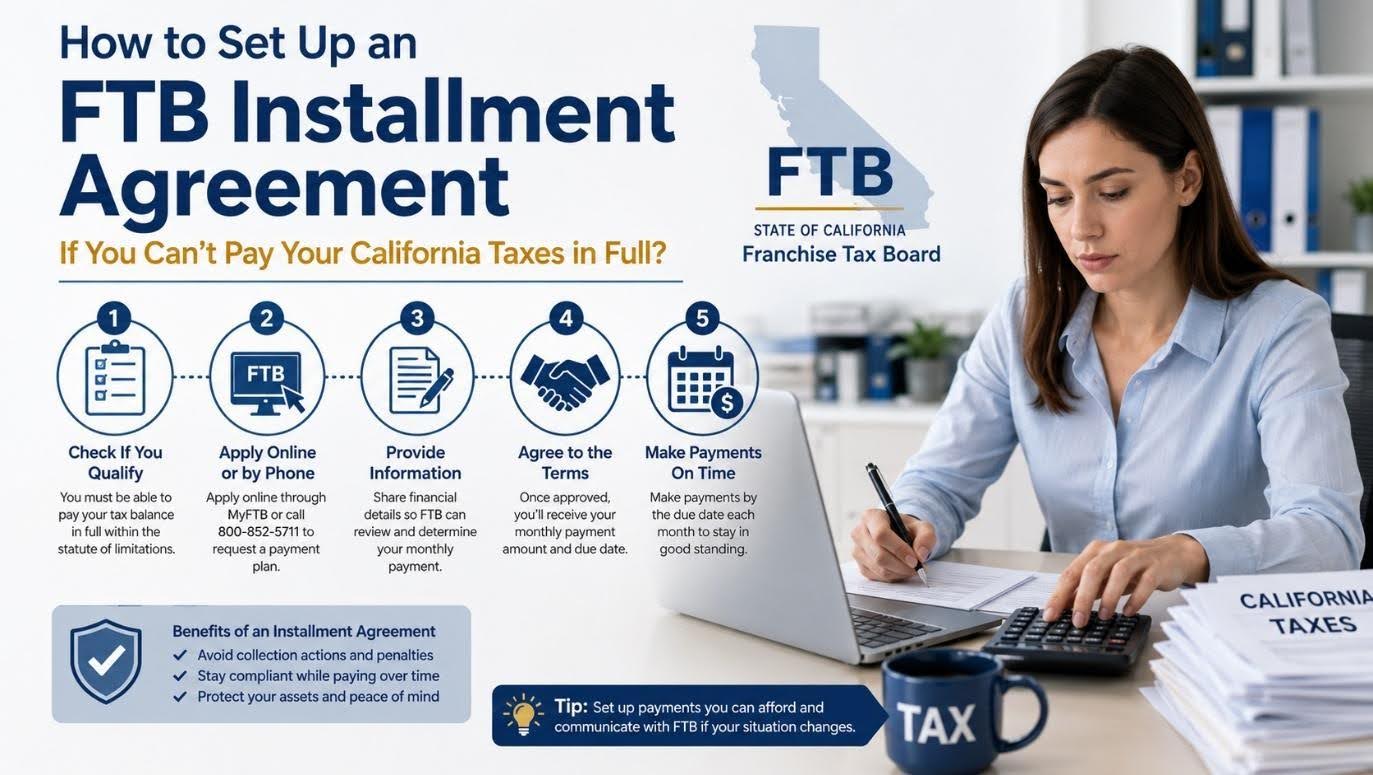
A California Franchise Tax Board (FTB) Installment Agreement lets corporate entities, LLCs, and partnerships pay back any past-due California state tax in monthly installments. An installment agreement provides a way for a business to pay its annual income tax, state income tax, or corporate franchise tax by making several payments over several years, rather than by paying it all at once on time.
An involuntary collection action like a bank levy or state tax lien is not used to collect taxes if the business is temporarily cash flow constrained.
Which Businesses Are Eligible for a Standard Payment Plan?
In order for an entity to be eligible for a standard business installment plan, it must be in good business standing in accordance with the basic business standing criteria established by the FTB:
No Ongoing Active Agreements: There should be no current active FTB payment plan or an active collection order (withholding order) outstanding for the business.
Demonstrated Financial Need: The entity must state that it does not have the liquid funds to pay the entire tax bill at once without having to interrupt the necessary operations of the business.
There is a Good Standing Intent, but distressed entities may apply for it, and to maintain or restore good standing, the entity must remain current with all current tax obligations. A California tax lawyer or other experts can help to set the standard payment plan.
What Are the Financial Thresholds and Payment Limits?
California has different time limits and periods for commercial taxpayers than for individual income taxpayers:
Maximum Cap: For tax liabilities of $25,000 or less (along with accrued penalties and interest), a streamlined and standard business installment agreement is applied.
Maximum Repayment Window: Individual taxpayers can be given up to 60 months, while those of commercial tax holders are usually paid off within 12 months.
Excess: Greater than $25,000 or more than 12 months to be paid: If your business is owed more than $25,000 or has that you can’t pay within 12 months, the FTB will need detailed financial disclosures (FTB 3567) and financial statements before deciding to approve your application.
What Compliance Rules Must a Business Fulfill Prior to Applying?
The FTB will not establish a formal payment plan until the business is totally compliant with state tax law:
Unfiled State Income Tax Returns: State income tax returns (e.g., Form 100, 100S, or 568) for the prior years must be filed. Where there are missing returns, the FTB can only approve a temporary Provisional Payment Plan, pending the processing of the missing returns.
Future Tax Payments: The entity will be obligated to make all future estimated tax payments and file future tax returns on time. The use of an IRS tax lawyer from Los Angeles or other places can make the case for a business.
Setup Fees & Direct Debit: Approved business plans will have a $50 setup fee added to the account balance along with a direct debit. The online setup usually requires that payments be set up to occur automatically at regular intervals using Electronic Funds Transfer (EFT) from a business bank account.
How Can California Businesses Submit Their Application?
Qualifying businesses can ask for a payment plan online through the FTB Business Entity Payment Plan portal with their 10-digit FTB ID or their Secretary of State ID number. Or entities may apply on a form called the FTB 3567 (Installment Agreement Request) via the mail or by contacting the FTB Business Entity Collection unit.
Conclusion
An FTB Installment Agreement offers the much-needed relief for businesses in California who are facing a short-term liquidity crisis. Your business can avoid being hit with major enforcement action, yet remain on the course to financial health, by ensuring that all state tax returns are filed, that all liabilities are at or below $25,000, and that you agree to abide by a 12-month payment schedule.