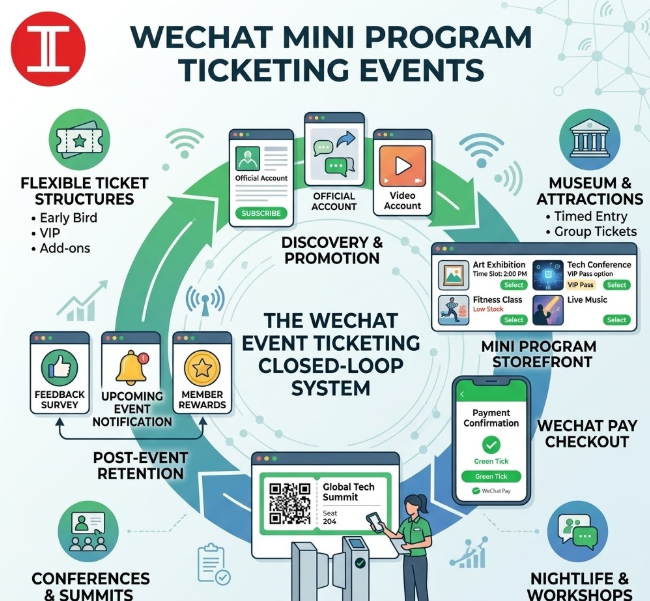
WeChat mini program ticketing events have become an important part of how brands, organizers, venues, and community operators sell access, manage guests, and keep engagement inside one familiar digital ecosystem. In China especially, WeChat is not just a messaging app. Tencent reported that Weixin and WeChat together had more than 1.4 billion monthly active users by 2025, which helps explain why businesses want ticketing, payments, customer service, and follow-up to happen inside the same platform. Tencent also said Mini Programs facilitated over RMB 2 trillion in GMV, showing how strong the transactional side of the ecosystem has become.
For event businesses, that matters a lot. A strong ticketing system does more than sell entry. It reduces friction, improves attendance, supports reminders, creates data for future campaigns, and gives organizers a smoother path from discovery to purchase. That is why the phrase wechat mini program ticketing events is drawing more interest from marketers, developers, and event teams that want fast mobile booking and better conversion without forcing users to download a separate app.
Why WeChat matters for event ticketing
The value of WeChat mini program ticketing events starts with convenience. Users already spend time in WeChat for chat, search, content, payments, and brand interactions. Instead of pushing people to a separate mobile app or a clunky browser flow, organizers can meet them where they already are. That shortens the journey from event discovery to checkout.
Mini Programs are built for lightweight, app-like experiences inside WeChat. Tencent describes Mini Programs as a way to turn user interactions into transactions, which is exactly what an event ticketing workflow needs. A person sees an event, opens the Mini Program, chooses a date or seat, pays with WeChat Pay, receives confirmation, and returns later for entry and updates.
That closed-loop flow is useful for more than large festivals or conferences. It also works for exhibitions, museum entries, workshops, fitness classes, nightlife events, business seminars, school activities, and private community gatherings. In every case, the main business goal stays the same. Reduce drop-off and make the purchase journey feel natural.
How WeChat Mini Program ticketing events work
At a practical level, wechat mini program ticketing events usually combine several core parts. The first is the event discovery layer. This may come from an Official Account article, a social share in chat or Moments, a Video Account promotion, a QR code on offline material, or direct search within WeChat. Tencent has highlighted the role of Mini Programs in native transactional experiences and closed-loop advertising, which shows how discovery and conversion increasingly connect inside the WeChat environment.
The second part is the event storefront. This is where the Mini Program displays event details, schedules, venue information, pricing, seating rules, ticket tiers, refund terms, speaker profiles, and urgency signals such as low inventory. Good event pages keep the design clean and the purchase path short.
The third part is payment. Mini Program payment flows rely on WeChat Pay support, which is one reason this model feels seamless for users. Instead of entering card data into an unfamiliar page, buyers can complete payment through a familiar wallet experience tied to WeChat. That matters because trust and speed both affect conversion. Official WeChat Pay documentation and implementation materials show that Mini Program payments are a supported payment scenario for merchants.
The fourth part is ticket delivery and validation. After payment, the buyer receives order confirmation and a digital ticket record. Organizers often use QR-based entry, dynamic order pages, or attendee codes that can be checked at the venue. WeChat also supports Mini Program code generation APIs, including unlimited code generation for large-scale business scenarios, which is highly relevant for distribution, event sharing, and check-in flows.
The fifth part is communication after purchase. A good event system does not stop at the receipt page. Mini Programs can work with subscription messaging flows so users who grant permission can receive relevant notifications such as confirmation, schedule reminders, gate information, or last-minute updates. Official Mini Program subscribe-message documentation is referenced across implementation libraries and developer materials.
What makes this model attractive for organizers
The main strength of wechat mini program ticketing events is that they bring marketing, commerce, and operations closer together. In a traditional setup, promotion may happen on social media, ticketing on another platform, payment through an outside gateway, and customer follow-up in email or SMS. Every handoff increases friction.
Inside WeChat, organizers can shorten those gaps. A campaign can run through content, private group sharing, brand accounts, search, and QR distribution. The same user can then complete a purchase inside the same environment and return to the same Mini Program later to manage the booking. That continuity helps reduce abandonment.
Another advantage is data. A ticketing Mini Program can capture useful signals such as page views, conversion rates, popular ticket types, campaign source, time-to-purchase, repeat attendance, and refund patterns. That does not mean event teams should ignore privacy or compliance. It means they can make smarter decisions about pricing, promotion windows, and retention campaigns.
WeChat mini program ticketing events also fit the reality of mobile-first behavior. Many users do not want to install a separate event app for one purchase. Mini Programs solve that problem by offering an app-like experience without a full app install. Tencent has continued to position Mini Programs as a major part of its consumer and business ecosystem, which supports the long-term relevance of this format.
Features a strong ticketing Mini Program should include
A useful ticketing Mini Program should start with a fast event page. If the page takes too long to load or forces too many taps before checkout, conversion will suffer. Clear date selection, price display, stock visibility, and location details matter more than fancy effects.
It should also support flexible ticket structures. Many event operators need early-bird tickets, VIP access, timed entry, group packages, discount codes, or member pricing. A Mini Program that only supports a single flat ticket type will limit growth.
The check-in layer is equally important. Organizers need a reliable way to verify attendees at the venue. That may include staff scanning, order lookups, or synced entry status. Smooth entry reduces queues and improves the real-world event experience.
Customer communication deserves equal attention. Buyers need reminders, refund instructions, weather notices, schedule changes, and venue guidance. Subscription-based notifications inside the Mini Program ecosystem can help event teams stay connected after the sale when users opt in.
Finally, a good system should support post-event retention. The biggest mistake many organizers make is treating ticket sales as a one-time transaction. The real value often comes from bringing buyers back for the next event, membership offer, or related product. WeChat is especially useful here because the relationship can continue through content, search, customer service, and future campaign touchpoints.
Business use cases beyond simple ticket sales
When people search for wechat mini program ticketing events, they often think only about selling passes. In reality, the business applications are broader. A Mini Program can support registration for free events, RSVP management for branded experiences, appointment-style bookings for limited-capacity sessions, exhibition slot reservations, and hybrid event attendance flows.
For example, a museum can use a Mini Program for time-slot reservations, membership verification, and on-site scan entry. A conference organizer can sell tiered passes, session add-ons, sponsor benefits, and digital materials. A nightlife promoter can drive traffic from group chats and KOL sharing into same-day ticket purchases. A retail brand can turn an in-store campaign into an RSVP event with check-in rewards and post-event remarketing.
This flexibility is one reason the model keeps attracting attention. It is not just about replacing paper tickets. It is about building a mobile event funnel that connects awareness, transaction, attendance, and loyalty.
SEO and content strategy around WeChat event ticketing
From a content perspective, the keyword wechat mini program ticketing events sits at the intersection of event tech, WeChat commerce, and China digital marketing. That means content should answer both strategic and practical questions. Readers want to know what Mini Program ticketing is, why it matters, how the payment flow works, what features matter, and what kinds of businesses benefit most.
Helpful content performs better than generic sales copy. A strong page should explain payment integration, attendee management, QR check-in, shareability, CRM opportunities, and campaign attribution. It should also acknowledge limitations. For example, success depends on market fit, local user behavior, merchant readiness, and operational execution. WeChat alone does not fix weak pricing, poor event pages, or confusing refund policies.
In SEO terms, natural semantic coverage also matters. Related phrases such as WeChat Pay for events, Mini Program event booking, digital ticketing in WeChat, QR code check-in, mobile event registration, attendee management, event CRM, and event promotion in China can strengthen topical relevance when used naturally.
Common mistakes to avoid
Many event teams treat the Mini Program as just a purchase widget. That is too narrow. A better approach is to see it as the operating center for the event journey. If the experience ends at payment, the organizer misses the retention value.
Another mistake is overcomplicating the interface. Event buyers want speed. Too many form fields, too much design clutter, or unclear steps can hurt sales. The best event flows feel simple.
Some teams also ignore trust signals. Refund rules, event legitimacy, venue details, organizer identity, and support access all affect conversion. Inside WeChat, users still need confidence before they pay.
A final mistake is weak post-purchase communication. Buyers who never receive useful reminders are more likely to miss the event, request support, or leave with a poor impression. For many organizers, operational communication is where the platform can create the biggest gains.
The future of WeChat Mini Program ticketing events
The long-term outlook for wechat mini program ticketing events remains strong because the model aligns with broader user behavior. People prefer fewer app downloads, smoother mobile payments, and native digital experiences. Tencent’s recent corporate materials continue to position Mini Programs as a major part of user transactions, ad conversion, and commerce activity inside the WeChat ecosystem.
As platform tools improve, ticketing experiences are likely to become more personalized, better integrated with content and search, and more useful for lifecycle marketing. Organizers that connect promotion, payment, check-in, and retention inside one clear flow will likely have an advantage over those using disconnected tools.
Conclusion
Wechat mini program ticketing events matter because they simplify the path from interest to attendance. They let users discover an event, pay through a familiar wallet, receive digital confirmation, and return for updates and entry without leaving WeChat. For organizers, that means lower friction, better operational control, and stronger opportunities for repeat engagement.
The biggest opportunity is not just selling more tickets. It is building a smoother event system that feels natural on mobile and keeps the customer relationship alive after the event ends. When event teams combine strong content, clean UX, reliable payment flow, QR-based check-in, and thoughtful follow-up, WeChat Mini Programs can become a serious ticketing channel rather than just a side experiment.
Looking for more biographies like this? Browse our celebrity profiles for similar reads.
FAQs
What is a WeChat Mini Program for event ticketing?
It is a lightweight app inside WeChat that lets organizers promote events, sell tickets, collect payment, issue confirmations, and manage attendee actions without requiring a separate app download.
Why do businesses use WeChat Mini Programs for events?
Businesses use them because they reduce friction. Discovery, purchase, and post-sale communication can happen inside one ecosystem, which can improve conversion and user convenience.
Can WeChat Mini Programs support digital ticket check-in?
Yes. Mini Programs can support QR-based ticket flows, digital order records, and entry validation processes that fit event check-in and attendee management needs.
Is WeChat Pay important for Mini Program ticketing?
Yes. WeChat Pay is one of the main reasons the model works well. It gives users a familiar mobile payment experience and helps reduce checkout friction.
Are WeChat Mini Program ticketing events only useful in China?
They are most relevant where WeChat usage is strong, especially in China-facing markets, Chinese consumer ecosystems, and businesses that rely on WeChat-based discovery, communication, and payment behavior.